
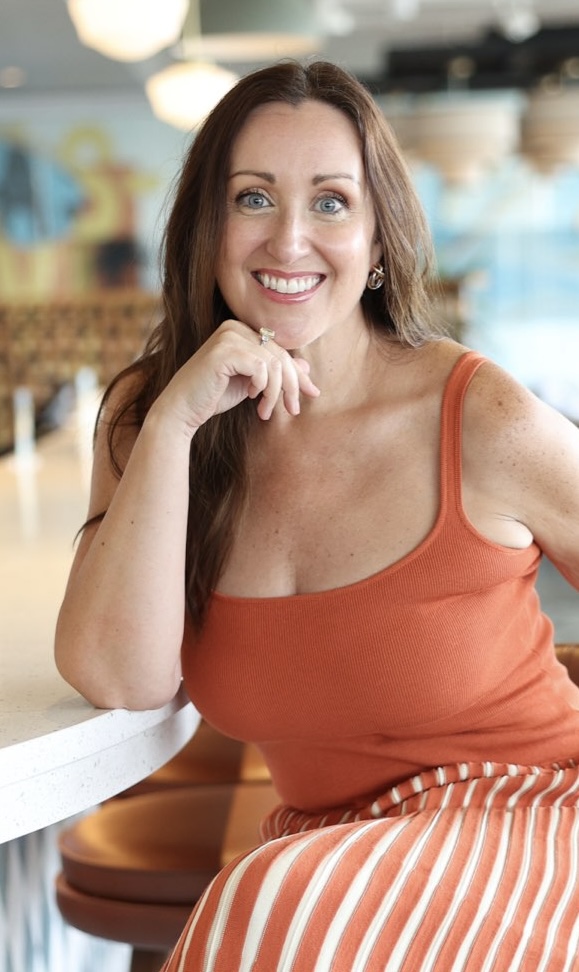
Sara Sweat, MA – Founder, Monarch
Last week, I shared a deeply personal story and discussed how it left me bracing for more disaster to unfold.
I talked about what it looks like to brace instead of live. And, how the low hum of dread can eat away at even the good things – like the life you worked so hard to create.
The response I got was overwhelming.
Message after message from people who said some version of the same thing: Thank you for actually saying it. I thought it was just me.
You’re not the only one, Monarch. Not even close.
So, this week, I want to double click on some of what’s at play here physically. On where the bracing comes from – even when we’re no longer in danger.
Because if you’re someone who has genuinely done the work — the therapy, the books, the self exploration. If you’re breaking the cycles that harmed you — and you’re still bracing, still waiting, still unable to fully exhale into your own life, you at least deserve to understand why.
Why Is Laundry More Important Than Lunch?
A few years ago, in the middle of a workday, I realized I was hungry. Like, uncomfortably, annoyingly, borderline “hangry” – kind of hungry. I was on a conference call and multi-tasking my way through it by folding my laundry.
Without needing to look at my calendar, I knew I had back-to-back calls until three o’clock and this was my only off camera meeting of the day.
A normal person would have stopped folding the towels and made a sandwich. But, as I hope I’ve established in my previous articles, I’m not really that normal.
So, instead of attending to my own needs, I kept folding the laundry. I put in another load of laundry. I knocked out the dishes and tidied up the den – all while fully participating in my call and coaching up my team.
By three o’clock, when my calls ended, I wasn’t hungry anymore. My body had given up on ever being fed and had responded with a headache and a foul mood.
But, it wasn’t until I was going to bed that night – still annoyed by the headache (that I hadn’t bothered to treat, by the way) – that I saw what I had done.
I had ignored my own needs in favor of household tasks. I’d prioritized my laundry over my lunch. But, why?
It took awhile to come up with the answer, but it all came down to ROI.
The Return on Investment is Wrong
When you grow up in an environment where your own needs are secondary — where quelling the chaos, avoiding the crisis, and preventing disruption always comes first — you learn to override yourself.
You learn to push your own signals to the back of the line. You learn that your hunger, your fatigue, your discomfort, even your fear, need to wait – because there’s always something more urgent.
You learn that your value is in doing. In intervening. In producing change. In mitigating risk and averting disaster.
So, when you do the return on investment analysis in moments like mine, your own needs have no perceived value. They don’t factor into the equation of how you spend your time at all – because everything is worth more.
In the weighted average of everything in your life – literally laundry is more important than you. Your nervous system perceives threat everywhere. Your value is in attending to that perceived threat.
Eating a sandwich doesn’t mitigate any risk. It doesn’t prevent anything bad from happening. So, self attunement and self care become luxuries that only even exist once everything else is done.
That’s why you can only finally exhale in your house – when everyone else is asleep. Or, when you’re alone and all your chores are done. That’s why watching TV, doomscrolling on your phone, eating or drinking becomes a crutch.
Because it momentarily shuts down the internal chatter that’s always saying “something bad is about to happen unless you stop it.” Those crutches subtly signal that you can let down your guard and stop bracing. And, you are desperate for permission to release.
When self-abandonment is your default setting, you might miss a lot of meals. Or, maybe for you – it’s committing to things that you have zero interest in doing. Maybe it looks like smiling when you’re actually unhappy. Responding to unkind words with nervous laughter and a nod of your head – instead of calling someone on their behavior.
It might be the vacation you went on but missed because you couldn’t stop working long enough to enjoy it. Or, the relationships you don’t have – because you can’t seem to let down your guard enough to let people in.
These aren’t personality traits. They’re not who you are. They’re patterns — learned, adaptive, outdated patterns — running on a system that was built for a world that no longer exists.
Because it’s Thursday – and you’re grown. Nothing is wrong right now. Actually, things are probably pretty good. You have a meeting in twenty minutes that you’ll run brilliantly. Your kids are okay. Your relationship is fine. Work is in the bag.
And yet.
There’s a vigilance you can’t quite turn off. A part of you scanning the horizon even though there’s nothing on it. A tightness in your chest that you’ve gotten so used to, you barely even feel it anymore.
That feeling is not your flaw. It’s not anxiety you haven’t managed well enough. It’s not evidence that you haven’t fully emotionally healed or worked hard enough or come far enough.
It’s your nervous system doing exactly what you trained it to do.
And you trained it very, very well.
You’ve Trained For The Wrong Thing
When we grow up in environments of chronic stress or unpredictability — in the presence of addiction, loss, abuse, neglect, any of the things that make a childhood feel unsafe — our nervous systems adapt.
They have to. The brain’s primary job is survival, and it is extraordinarily efficient at learning what it needs to do to keep you alive.
It learns to stay on high alert. It learns to scan. It learns to read rooms, anticipate danger, and brace for impact. It builds a threat-detection system that is so finely tuned you can probably tell what your partner is thinking before they even know it themselves.
But, here’s the part nobody talks about enough: that system doesn’t automatically turn off when the threat is gone.
The brain doesn’t get a memo that says the crisis is over. It doesn’t know you moved out of that house, left that relationship, built that career, learned those skills. It knows what it learned — that danger is real and it comes without warning — and it keeps doing its job.
Psychologists call this hypervigilance. I call it “the brace”. And what makes it so invisible, especially in high achievers, is that it doesn’t look like fear. It looks like competence. It looks like being prepared. It looks like the person who always has a plan, always sees what’s coming, always knows what to do in a crisis.
People at work used to call me “The Oracle” – because I could always predict what was going to happen in the human dynamics of our workplace. But, it wasn’t some magical gift that created that ability – it was a nervous system that couldn’t shut itself off.
The Good News
There is good news in all of this bracing and automatic behavior. And, here it is.
If your nervous system was trained to be hypervigilant through relationships and experiences – it can be retrained by them, too.
You can teach your mind and body to stop doing the mental calculous that always serves you up the short end of the stick. You can amass a set of experiences that will help you stop bracing and start living.
Neuroplasticity, the brain’s ability to reorganize in response to new stimulus, is your new best friend. It worked to protect you in those early days. And, it can also work to unravel that early programing so you can actually enjoy your life.
You can create a new pattern of behavior that helps your nervous system recognize that the threat is over. You can teach it how to respond with a presumption of safety. You can learn how to aim that finely tuned perception at things you actually want more of.
Like, beauty. And, fun. And, enjoyment.
And, the best part? That path forward is WAY easier than everything else you’ve already survived.
Therapy heals the wound. It doesn’t automatically rewire the alarm system that formed around it. And for most of us — especially the high achievers – we have conflated that alarm system with our value. With our success.
But, what you will find when you start doing this work, is that you’ve only begun to scratch the surface of what you’re capable of. When your nervous system isn’t perceiving unfolded laundry as a three alarm fire and you actually eat your lunch – you’re going to be unstoppable.
So, Try This
The path forward isn’t going to go as quickly as you want it to. That’s something you’ll have to learn. But, the change will happen faster than you think. And, you can start right now.
Try one small thing for me this week.
Pick one moment — just one — where you override a signal your body is sending you. The hunger, the tiredness, the need for quiet, the desire to say no. Just notice it.
You don’t have to change anything yet. I’m not asking you to do it differently. Just see it. See it – and tell me what is was.
Because noticing how your alarm system is wired is the first step in turning it off. And, community really helps. So, let’s do this, together, ok? It’s way more fun that way.
Monarch is coaching and community for high-achieving trauma survivors who are done surviving their lives. If this resonated, share it with someone who always seems like they have it all together — they might need it most.
Subscribe to stay with me as we architect what comes after.