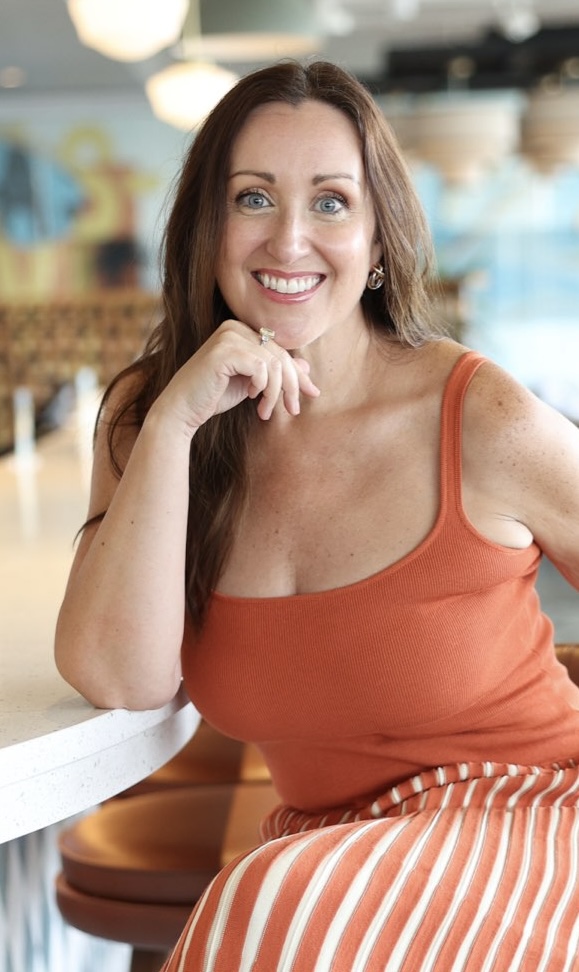
Sara Sweat, MA – Founder, Monarch
I was still a child when I understood that the adults in my life were not going to be okay. By fourteen, I’d lost my father to a heart attack, my mother’s attention to addiction, and any sense of safety to the chaos both realities brought.
No one knew what was happening in our home. To the outside world, everything looked as expected. My brother and I made it to school every day. My mother made it to work. But, when five o’clock rolled around each night, a familiar scene began to play out.
It started with my mother’s traditional evening cocktail – which turned into two, then three, then four – then counting didn’t really matter any more.
Drinking. Crying. Rage. Wash. Rinse. Repeat.
There is no peace in a home with active addiction, but I was doing my best to stand in the gap. To show up. To help. To avert disaster.
One night, my mother’s usual routine intensified. Her sorrow over my father’s death became too much and, taking the car keys from the kitchen counter, she threatened to kill herself.
She didn’t, thankfully. But, what stopped her wasn’t what it should have been. It wasn’t the other adult in our home at the time – who just kept casually washing the dishes. It wasn’t a sudden realization that she wanted to live or a serendipitous interruption like the phone ringing or a neighbor stopping by.
It was me.
Reading her moves like a well worn book. Interrupting her trajectory. Offering alternatives to the end of life and distracting her from her plan. It was her child.
If you’re a high achiever who’s been through hard things – you might recognize this scene. Maybe not the exact details. But the feeling.
The remembrance of what it felt like to be the one who had to hold it all together. The terrifying realization that no one was coming to save you. The acceptance that you had to step up and be the adult – even though you had no idea how.
The Legacy of Hard Things
When high achievers go through hard things, we get good at doing them. So good that eventually hard things don’t even register as hard anymore. Survival doesn’t feel like survival – it just feels like life. Like, who you really are.
I built a career on my ability to do hard things. A good one. The kind that looks impressive from the outside, the kind that makes people say ‘how does she do it all?’
I became someone who could walk into any room and figure out exactly what was needed. Who could read people before they’d finished their first sentence. Who could hold complexity together, manage chaos, deliver results, and keep the whole team winning.
I did the hard healing work. I ended the generational patterns that plagued my family. And, I built a life of which I was proud.
The same skills I learned as a child served me well as a adult. And, for a long time, I thought my success story was the pinnacle of my life. From trauma to triumph – look how far I’ve come.
But, quietly inside, everything was falling apart.
Professional burnout, harmful relationships, and devastating losses marked my life. And, it seemed like everything that could break, did. A lifetime accumulation of hard things hit all at once. And for the first time in my life, I didn’t have the energy to push through.
I couldn’t hustle my way out. I couldn’t out-perform the pain. I couldn’t hold everything together.
So, I stopped trying. I gave up. And, let the enormous waves us life bowl me over, cover my head, and carry me away.
But, what came next was a surprise. I had expected that finally admitting I wasn’t okay would crush me. That acknowledging how lost I was would feel like a piano being dropped on my head.
But, in my surrender – in the acceptance of my own humanity – I didn’t find the shame and isolation I had expected. I found stillness. Gentleness. And the clarity of one simple question.
*Why, after everything I’ve built, does it still feel like I’m just surviving my life?*
The True Cost of Survival
The life I built was real. The healing I did was real. The cycles I broke were real.
But I had built everything — every achievement, every relationship, every identity — on the foundation of my survival skills. And survival skills are genuinely extraordinary. They kept me alive. They made me good at my work. They made me someone people counted on – someone who could create success.
But, living my life in survival also meant that every time a crisis was over, my whole system kept running like it wasn’t. It kept guarding and preparing and waiting for the other shoe to drop.
I was still bracing.
Still scanning for the next thing to go wrong. Still waiting for the impending crash. Still unable to fully relax into the life I’d worked so hard to create.
In spite of all my success, some deep, wordless part of me was convinced that if I let my guard down for even a moment – everything would fall apart.
I was so entrenched in survival that it didn’t even occur to me that it was something that could change.
I didn’t know there were other people — high-achieving, capable, seemingly fine people — living with the same low hum of dread underneath everything they ever did.
But, I know it now. And, I hope you can begin to know it, too.
So, if this all sounds eerily familiar, if you are someone who has been through hard things and built a successful life, but still can’t take a deep breath, this is for you.
You are not broken. You are not weak. You are not doing it wrong.
You are bracing.
You are stiff arming joy because you are still expecting another ‘gotcha’ around every bend. You are armoring up against the unseen disaster you just know must be coming. You are bracing for the chaos that always, always came.
But, whatever happened to you that taught you to brace – you are no longer there. You’re not in that house anymore. You’re not with those people. The danger has passed.
You’ve broken the cycles, healed the hurt, and built a life that “little you” couldn’t have dreamed of.
The crisis that taught your nervous system to brace is over — even if your body hasn’t gotten the message yet.
The Other Side of Bracing
I have to believe there is something on the other side of all of this. Not more hustle or achievement. Not another thing to fix or heal or optimize.
But, ease. Presence. Joy that doesn’t come with dread attached.
A life you can actually be in, not just manage.
And, honestly, I’m building that life right now. I’m not writing this from the mountaintop. I don’t have all the answers and I don’t have it all figured out.
But, I’m standing on the precipice — and I can see the life we all deserve clearly. And, I’m learning, slowly and imperfectly, to step into it.
I started Monarch because I kept meeting people like us. Accomplished, brilliant, quietly exhausted rockstars. People who always look okay. People who have done the therapy. People who have read the books, broken the cycles, and burned the sage.
People who are still waiting, somewhere underneath all their survival and success, for the other shoe to drop.
You deserve to know you’re not alone in this. You deserve to know that what you’re carrying is real. And you deserve to know that what comes after surviving is not more survival.
It’s a life.
Monarch is coaching and community for high-achieving trauma survivors who are done surviving their lives. If this landed for you, let me know. And, share it with someone in your life who always seems a little too okay.
*Subscribe to stay with me as we architect what comes after.*