
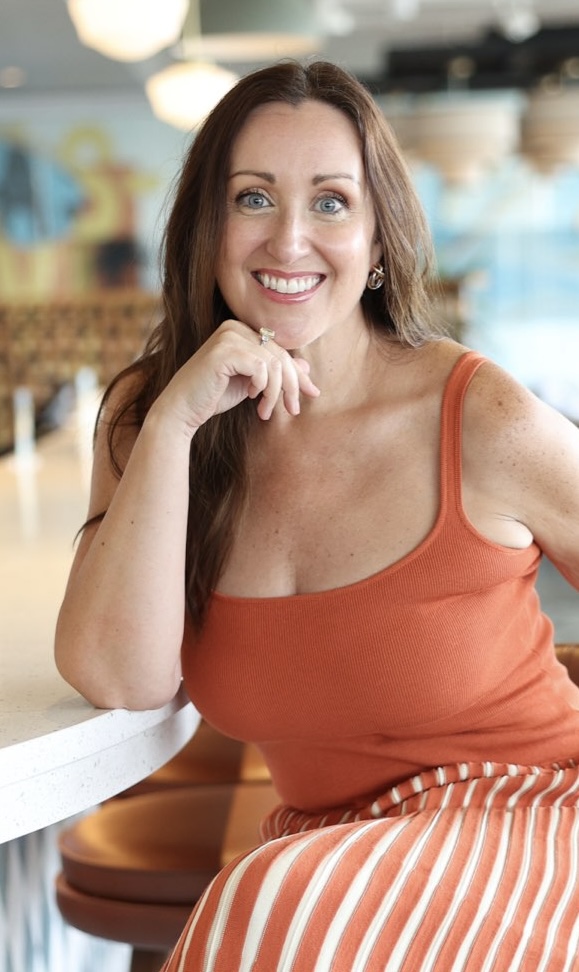
Sara Sweat, MA – Founder, Monarch
I love Christmas time. I put up my holiday decorations before Thanksgiving (don’t judge me) and bask in their warm glow. I love the cooler weather, the twinkly lights, and the permission to get warm and cozy and basically drown in my couch.
But, by December 26th, I’m ready for a change. And, I really need my house back.
The charming holiday decor starts to feel like clutter to my sensitive nervous system and I need a reset. Like…now. Not in a determined “it’s time to take everything down” kind of way. It’s more of a, “I feel like I’m suffocating and I’m going to have to burn the house down if I don’t clean it up” level of urgency.
This happens a lot with tender nervous systems that have been through too much. We’re good – until we’re not. Coping mechanisms and care strategies can buy you time – but eventually, you need to address the trigger.
Knowing this about myself, I usually have a plan in place for support. I handle all the small things in the days following Christmas. And my dear “framily” (friends who have become family), help with the big stuff – like my 9 foot tall, long branched, pre-lit Christmas tree. They help me disassemble it and carry the heavy bags upstairs to the storage closet.
This year, however, was different. My support team wasn’t available to help. So, when the sight of an undecorated, unlit, enormous conifer in my den felt like too much – I decided to take matters into my own hands.
Like a persistent and determined toddler stomping her feet and saying “I do it myself!!”, my hyper independence took over. For about an hour, I wrestled with a scratchy, heavy, and awkward tree nearly twice my size. It wasn’t pretty.
I cut my hand. I pulled a muscle. There was cursing. There was groaning. There were even what Walt Whitman might characterize as “barbaric yawps” as I loaded enormous green plastic tote bags with twisted branches and dragged them up the steps of my home.
When the chore was done, I could have felt proud. After all, I had done something I wasn’t sure I could – even though it had been hard. But, instead of feeling accomplished, all I felt was mad.
Like, really mad. White hot rage, fire shooting out of my eyes, that chick is not ok – mad. Not at anyone or anything in particular – but at all of it. At the “stupid tree”, at the life events that made it impossible for my support team to help, at everyone I’d ever met who told me they’d be there for me and bailed instead.
I even took my hypothetical, future partner to task for not coming into my life early enough to help me de-decorate my house.
“I just can’t do this.”, I heard myself say exhaustedly as I rolled my eyes at the absurdity of that statement – in light of what I’d already done.
I’ve been playing out scenes like this with myself for decades. Saying I can’t do something and then shoving a round peg into a square hole and doing it anyway.
Treating my genuine observations and heartfelt boundaries like hogs-wallop and telling myself to “suck it up, Sweat”. I could do it. It could be done. It was just going to hurt.
So, here I was again, forcing myself to go beyond my capacity because of an innate belief that “someone had to” and that “someone” needed to be me.
If you’re a high achieving trauma survivor – this pattern probably sounds familiar. For most of us, hyper-independence usually starts out as adaptive.
It comes from a time when we had to function beyond what was reasonable – because we were the only one who could. But, once we navigate the trauma or exit the unhealthy environment, this strategy creates more problems than it solves.
I mean, I’m a grown ass woman with friends and neighbors and a helpful and loving second grader who I could have asked for help. And, yet, I was responding to my own plea for support with apathy and disdain.
There I was – a trauma informed coach who helps high achievers build sustainable, enjoyable lives – making my own life a rerun of the trauma I’d already survived.
The win? I noticed. I realized what I was doing. And, I stopped before I spiraled into a days long grump fest of irritation and loathing. Because healing doesn’t mean we never get triggered. It doesn’t mean we handle every situation perfectly or never lose our cool.
Healing looks like honoring ourselves enough to listen to our own needs and address them with compassion, patience, and love. I was clearly feeling overwhelmed and unable to do it all.
So, I listened to myself.
I believed myself.
I cared about my own experience and went about the business of getting what I need.
The next day, I called a friend for support. We talked it though – in that way only fellow survivors can – and put a plan in place to create another layer of support. I reached out to neighbors and fellow solo moms to get some fun things on the calendar. I returned to the infrastructure that allows me to stop surviving my life and actually live it.
Most importantly, I kept listening. To my thoughts and needs and choices. To my inner requests for the things that give me comfort and peace. And, I allowed my nervous system to reset and my capacity to return to normal.
Hyper-independence whispers that asking for help is weakness. But the real strength? It’s in recognizing when we’re white-knuckling our way through life and choosing something different. It’s in remembering that ‘I can do it myself’ doesn’t always mean ‘I should.’
What’s your Christmas tree today? What are you wrestling with alone that would be easier if you’d ask for support? And, how can I help?