Sara Sweat, MA – Founder, Monarch
There is a kind of adult who moves through the world carrying weight that was never theirs to bear.
They are, almost universally, high achievers. Highly capable. Often successful. The people others depend on and no one even thinks to check on – because they always seem ok.
They’re often described as resilient, strong, and inspiring but few ever ask how they became that way.
They are the cycle breakers. The people who served as the canary in the coal mine of their families. They saw the dysfunction around them, called it what it was, and built their whole life and identity around doing it differently.
And, it wasn’t an easy road. Being the most perceptive person in a system that can’t tolerate being accurately perceived isn’t exactly for the weak.
Highly sensitive people — a neurological trait present in roughly 20% of the population make up a significant portion of cycle breakers. They often process sensory and emotional information more deeply than others, have stronger emotional responses, and are more attuned to subtleties in their environment.
In a functional family system, this trait is an asset. In a dysregulated one, it becomes a liability — because the child feels everything the adults are refusing to feel, and gets labeled accordingly.
“Dramatic.”
“Too much.”
“Too sensitive.”
“All wrong.”
The Architecture of the Cycle Breaker
Cycle breakers are not a personality type. They are the product of a specific set of circumstances: being born with high sensitivity or emotional intelligence into a family system that required you to use it in service of everyone else’s regulation — before you ever learned to use it in service of your own.
The result is a predictable architecture. High external competence. Deep internal exhaustion.
An almost reflexive orientation toward other people’s needs with a lifelong sense of being a stranger in every room — fluent in a language nobody else around you was speaking.
Judith Herman’s landmark research on complex trauma established that the most significant psychological cost of chronic childhood stress isn’t a single traumatic memory — it’s the cumulative effect of an environment that required ongoing vigilance, emotional labor, and self-suppression.
The child who grows up tracking the emotional temperature of every room doesn’t have a hard childhood – they basically don’t have one at all. They may even have limited memories of their childhood – because they were too busy reading the room to make them.
As children, they developed a nervous system permanently calibrated for threat detection — which, ironically, in adulthood looks exactly like high performance.
The hypervigilance that kept you safe becomes the drive that builds your career. The self-sufficiency that protected you becomes the competence everyone depends on. The emotional intelligence that made you the family’s barometer becomes the thing that makes you exceptional at your work.
None of it disappears. It just gets redirected — and eventually, it runs on fumes.
Because for most of us, the very armor that protected you becomes the thing keeping you from inhabiting your own life.
Why High Achievement Is Not the Same as Being Okay
One of the most persistent and costly myths about cycle breakers is that their success is evidence of their healing.
It’s not.
Success, for most cycle breakers, is a continuation of the original survival strategy — just executed at a higher level.
The same nervous system that learned to perform competence under pressure in childhood learns to perform competence in boardrooms, in leadership roles, in families of their own.
The outcomes change. The operating system doesn’t.
Decades of research on ACEs (Adverse Childhood Experiences) found that high-achieving adults with histories of childhood adversity showed significantly elevated physiological stress markers — even in objectively non-threatening environments.
Their bodies were still bracing for disaster while their high achieving results gave no indication of it.
This is why cycle breakers are often, statistically, at the highest risk for burnout, acute health issues, and chronic disease. But, they’re so good at spinning the plates, they are among the least likely to be asked if they’re okay.
They have spent decades becoming convincingly fine. The performance of okayness is so embedded, so automatic, that the people closest to them rarely think to look underneath it.
People call them brave. It always makes them a little mad. Because bravery feels like a choice – and survival doesn’t give you one.
The Three Things Cycle Breakers Most Need to Hear
1. You are not broken.
What feels like brokenness — the hypervigilance, the difficulty with rest, the inability to receive care, the loneliness that persists even inside good relationships — is not damage. It is adaptation. An extraordinarily intelligent adaptation to circumstances that required it.
The goal is not to fix what’s wrong with you. It’s to update an operating system that was built for threat detection to one that starts scanning for joy.
2. The loneliness is real — but it doesn’t have to stay.
Cycle breakers often feel lonely regardless of how many people are around them. If you’ve spent your whole life viewing other people as threats you need to mitigate, a sense of isolation makes a whole lot of sense.
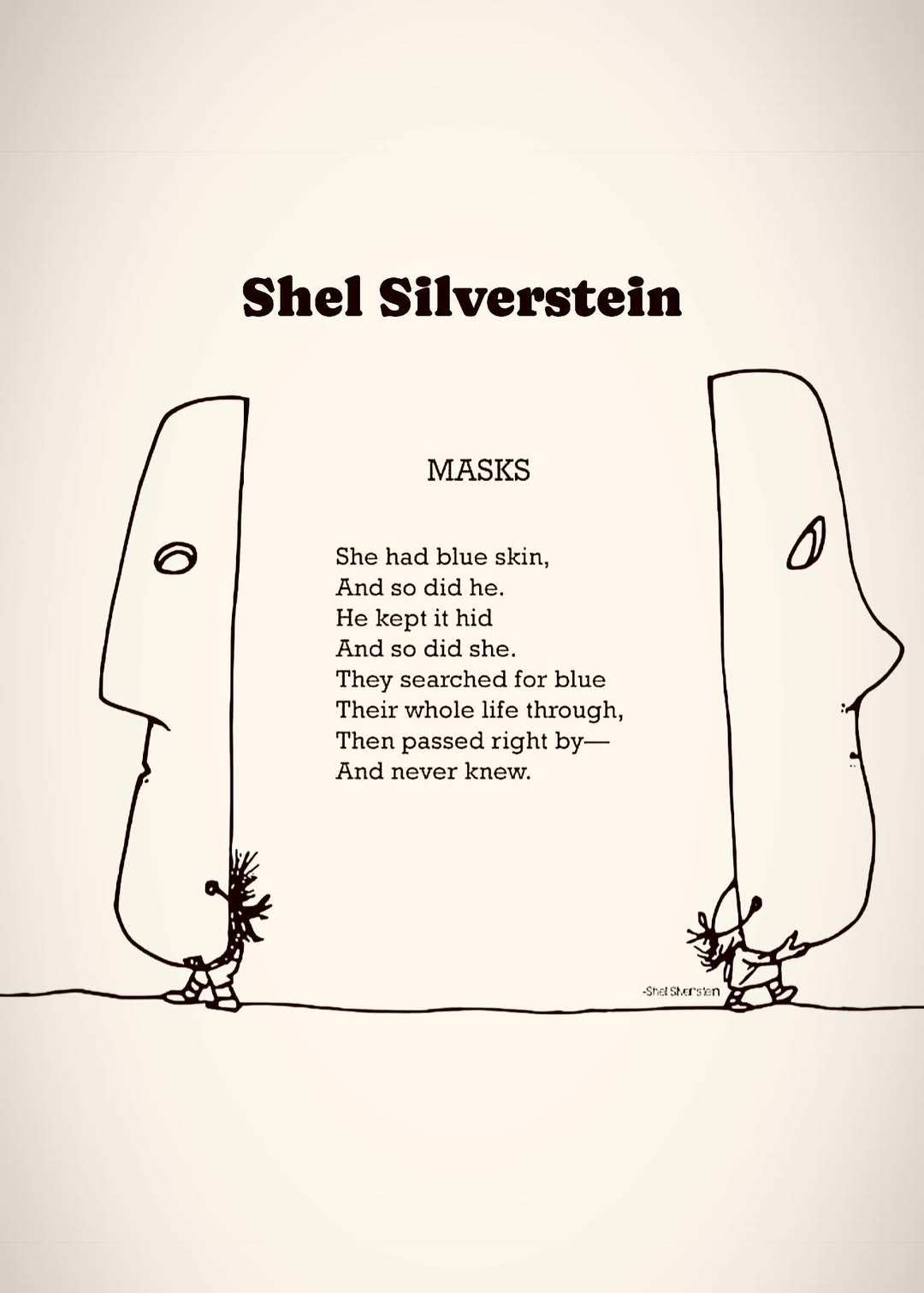
The problem is that cycle breakers have gotten so good at surviving, no one recognizes they are. All armored up, like the characters in Shel Silverstein’s poem Masks, we walk right past one another never realizing we’re not alone.
Community is possible when we stop performing our life.
3. Survival was never the destination.
The cycle breaker who has done the hard work — who has built the success, interrupted the patterns, and refused to pass down what was handed to them — has accomplished something genuinely rare. So, if “making it out” is the entirety of the reward, I’m not sure the ROI is there.
The process doesn’t end with breaking the cycle.
Breaking the cycle is day one of your actual life.
Monarch was created to be the space where you finally get to live it.
An Invitation
If you’ve been breaking cycles on your own and feel like no one understands – Monarch is for you.
If you’ve been performing your life for so long that you aren’t even sure who you are without it – Monarch is for you.
If you’ve been isolated because it’s the only way you could be sure you’re safe – Monarch was built with exactly you in mind.
We’re launching a community.
A place to rest. To take off the masks. To get to know who you are on the other side of survival with other people who are doing it, too.
A place that doesn’t need anything from you, doesn’t ask anything of you, and is purpose built for the life you’ve worked so hard to create.
You were born this way for a reason. And, it’s time to uncover it now.
If you’re ready to learn more, let us know here. And, subscribe to stay with me as we architect your after.