
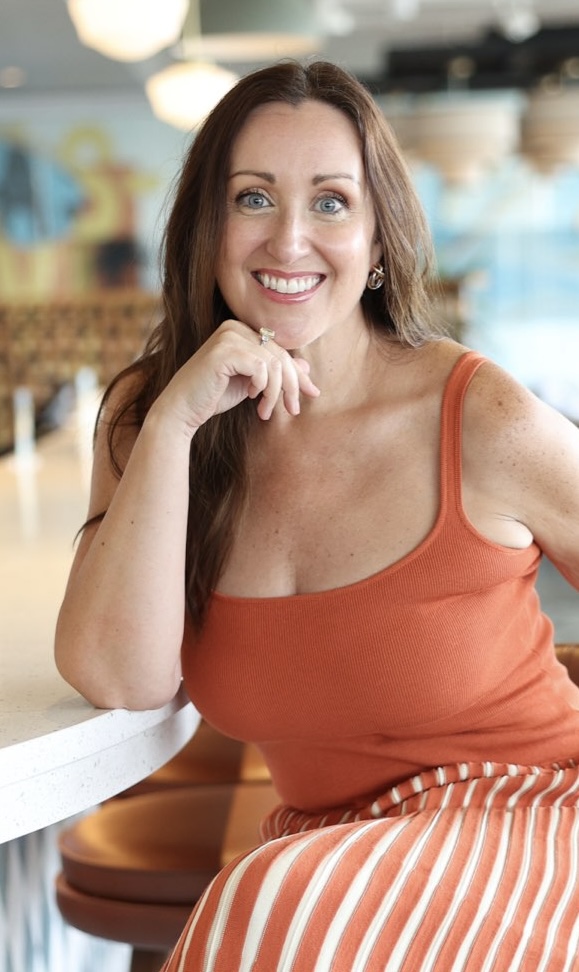
Sara Sweat, MA – Founder, Monarch
It’s Tuesday.
You awoke before your alarm – because your brain was already running before you opened your eyes. It serves up its usual – a mental inventory of past, present, and future – always running quietly in the background of life.
The thoughts shift between topics quickly. The project you’re working on. The email you still need to write. That thing you said in a meeting two weeks ago that you’re still not sure landed right. The hard conversation you’re rehearsing. Your concern for a friend.
You don’t reach any conclusions from these thoughts. They aren’t going anywhere. But, you also don’t really try to shut them off.
You switch gears into productivity mode. By 8 am you have already done more than most people do by noon.
You work through lunch — not because you have to, but because stopping feels hard and pushing through, familiar.
You lead calls with skill. You anticipate risk and advocate for its mitigation. You design and create and meet or exceed all expectations.
At some point in the afternoon you realize you haven’t had water since the morning. You note it but don’t do anything about it just yet. You keep cranking out the work. Jumping from call to call, patient to patient, or task to task.
By evening you’re tired – but not just physically. Tired in a weary, fatigued way that leaves you hollow, dissociated, and mildly dissatisfied in spite of your well executed and productive day.
But, you rally, maybe make a drink, and go out to dinner with friends. You participate in their conversation – but mostly with rehearsed answers and reused scripts – a highlight reel of your life carefully curated to align with everyone’s expectations of who you really are.
You laugh. You nod. You’re only half listening, but that’s all you really need to do to get the gist of what everyone’s saying. You leave earlier than you need to and listen to a podcast on the way home.
As you lay your head on the pillow, in the quiet just before sleep, the inventory starts playing again in your head.
Tomorrow’s list. The thing you didn’t finish. Those goals that might need to shift. Your worry about next week.
And, like a TV accidentally left on in another room, the programming keeps playing until eventually, you fall asleep.
This was a normal Tuesday. Maybe even a good one.
You did everything that needed to be done. You checked the boxes, created value, saw your friends, maybe even received some positive feedback on your work.
You’re good at what you do. Known for being good, in fact. The person everyone relies on to get the hard stuff done. The default adult in every group.
Your reputation used to make you proud. But, you stopped feeling accomplished a long time ago. Now, you’re just playing the role. Living in the skin of who you used to be.
And, spending most of your time – active, productive, achieving – but somewhere on a continuum between frustrated and numb.
You are surviving your life. Running it on sheer will, momentum, & survival skills. And, like most high achievers, it’s all you’ve ever known.
Stage One: Adapt
Nobody develops survival skills on purpose. They’re an adaptive response to something you couldn’t handle on your own.
A home that wasn’t safe. A parent who wasn’t present. A childhood that required you to be more capable, more perceptive, more functional than you had the ability to be.
But, it doesn’t have to be something big and awful. Maybe it was a judgy uncle. Or, a school bully. Or the loss of a distant relative that changed a steady dynamic in your home.
Whatever it was, it created a persistent challenge, a chronically unmet need, or an environment that just wasn’t suited to who you were. And, your body bridged the gap.
Like we discussed last week, your nervous system is obsessed with you. It cares about you – and no one else. And about your safety more than your wellness, your health, or your peace.
So, when you were young and something in your world made you feel unsafe – your nervous system sounded the alarm.
It flooded your system with stress hormones and put your body into one of the four threat responses we discussed. Fight – Flight – Freeze – Fawn.
You developed survival skills in alignment with your body’s chosen adaptation to each perceived threat.
If you spent a lot of time in Fight – maybe you learned to make yourself strong, to preemptively defend, to shout down anyone who tried to get close.
If your go to was Flight – maybe you learned how to retreat or how to simply not be there when things fell apart.
If your system defaulted to Freeze – you stopped. Like a scared animal sensing a predator in the forest, you learned how to be invisible. How to avoid being noticed and how to hold so much tension in your body that your feet feel made of lead.
Maybe what worked best in your environment was Fawn. Go along to get along. Be helpful. Be flattering. Allow everyone around you to see their own idealized self reflected in your eyes.
Regardless of your default adaptation, you learned to stay hypervigilant to threat, to notice details others miss, and to intervene in ways that dramatically alter the systems and environments to which you belong.
These weren’t choices. They were responses. Brilliant, necessary, sometimes life-saving responses to threats that required them. And, they did what they needed to do. They kept you alive.
And, they became the origin of your edge. The thing that makes you exceptional. The reason people call you the best, the one who always knows what to do, the person everyone turns to when things fall apart.
It started as adaptation. It started as survival.
And then it worked.
Stage Two: Achieve
The skills you developed to survive your hardest circumstances turned out to be extraordinarily useful in the world.
The ability to read a room — built in a household where reading the room was the difference between a calm night and a crisis — translated directly into leadership. Into influence. Into knowing what to say and when to say it in rooms where the stakes were high and the margin for error was small.
The ability to perform under pressure — built in circumstances where there was no one else to step up — became the thing that got you noticed. That got you promoted. That made you the “go to” resource to do impossible things.
These golden threads – these useful applications of hard won skills – helped you achieve. And the world rewarded you for it.
Which meant you kept leaning into the skills. I mean, of course you did. They worked.
The applause kept coming. The recognition. And every time you performed, every time you delivered, each instance when you held it all together while everyone else was spinning out — it confirmed what you already believed.
This is how I create value. This is how I find worth. This is how I stay safe.
You became the default high achiever in every room you walked into. At work, in your family, in your friendships. The one everyone calls. The one who handles it. The one who can be counted on to figure it out, hold it together, and make it work.
You built a big, beautiful life with these survival skills. You built your success.
But, success built on survival skills…still feels like survival.
And, at some point the cracks begin to show.
Stage Three: Attach
Gradually, invisibly — your survival skills stopped being something you used and became something you were.
The strategy became your personality. And, the adaptation became your identity.
You stopped being a person who was capable of extraordinary things under pressure and became a person who could only do high pressure and extraordinary things.
Anything less than life or death stakes became boring. And, life outside of chaos evolved into some kind of weird limbo, disguising the next threat that lay hidden just out of sight.
These adaptive strategies – developed for a specific season of your life – were meant to get you through hard times. They were meant to temporarily avert disaster. To ride out inconsistency or challenge.
They were never meant to be the entire architecture of your life.
But when high achievers build our success on our survival skills – we get so good at being great that anything less feels unsafe.
The rewards get so consistent, the expectations so embedded, that our survival skills stop feeling like an advantage.
They become the only way we know how to operate. The only way we address a challenge. The only identity that feels solid enough to stand on.
So we hold on to it like our life depends on it because something inside of us believes that it does.
We can get so used to this being our reality, that it doesn’t even occur to us that something is wrong.
When we’re in the Attachment phase of our survival skills, it shows up in a lot of different ways.
- Rest doesn’t feel restful — it feels like falling behind. So, we numb instead.
- Ease doesn’t feel like relief — it feels like laziness. So, we create complexity to give ourselves something to do.
- Work becomes our default excuse, the most comfortable place to be — because its clear metrics and defined outcomes create a positive feedback loop about our value.
- We feel exhausted and lonely, but keep pushing past it because there’s always something else that needs to be done.
- We feel resentment, shame, or a quiet simmering rage nearly all the time, but assume the problem is us.
We write all this off as normal life – because to us, it is.
We think “I’ll feel better when this project is done” or “if I can just get through March, things will slow down”.
But, in reality, relief never comes. Because we don’t know how to create it.
We don’t know to give ourselves permission to stop surviving and even if we could, we have no idea how.
Now What?
If this is all sounding terrifyingly familiar, welcome home. Monarch was created precisely for you. You are most definitely not alone and this is so not where your story ends.
Because there is a fourth stage in our journey with survival skills and it’s at the heart of everything we do here together.
Ascend.
Moving from Attachment to Ascension is not about abandoning our skills. We don’t dismantle our superpowers or become some softer less effective version of ourselves.
Because, like how would that help?
You’ve still got shit to do. And, people depending on you. And, goals and dreams you haven’t even touched yet.
Ascending isn’t about doing less. It’s about doing differently. About building a new way to operate — sourced from your whole self, not just the parts that were forged in the fire.
It’s about achieving from a foundation of sovereignty rather than survival. About success that’s sustainable, enjoyable, and alive.
The survival skills you’ve worked so hard on get to stay. You just stop using them to survive.
You stop being a one trick pony and put all your superpowers to good use building the life and career you actually want – instead of the ones you think you have to have.
We’ll talk more about Ascend next week. But, in the meantime, I want to invite you to begin to dream.
What would a life built outside of survival look like?
What dreams have you delayed because the urgent and important of it all never seem to relent?
How would your ideal Tuesday look – not the hollow, unfulfilling version I described – but the one filled with purpose, energy, and joy.
Share your answers in the comments. And, start shaking off your wings. Because, what comes next is a whole new way to achieve. To succeed. To fly.
Monarch is coaching and community for high-achievers who are done surviving their success. If this named something you’ve never had language for before — subscribe for free now. And, share it with someone who is always the most capable person in the room, but you wish you knew better.