
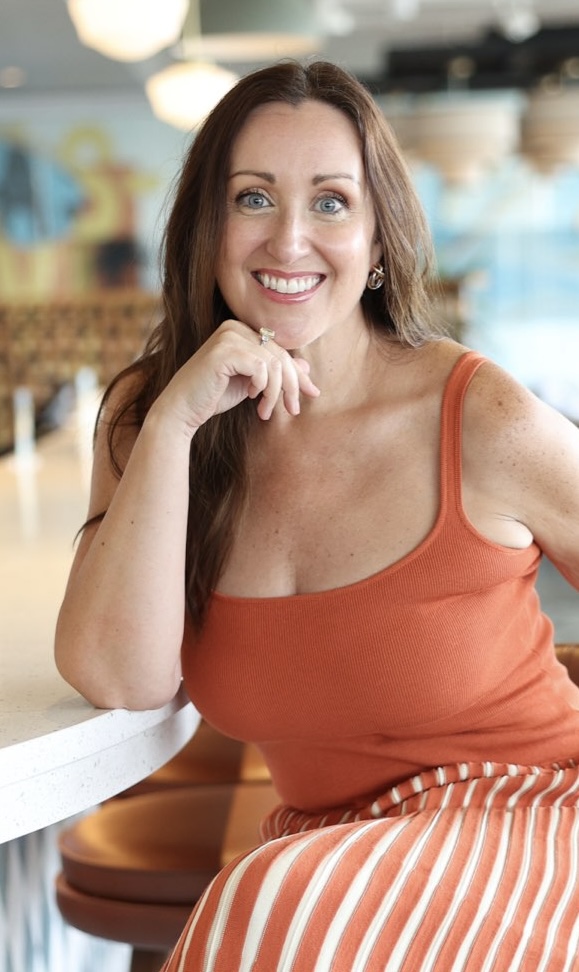
Sara Sweat, MA – Founder, Monarch
As a high achieving cycle breaker, I think a lot about the importance of the decision I made to end the harmful cycles in my family. To be the first in generations to name the dysfunction that had embedded itself in our lives.
I was the first to see what early family losses had done to our home. The first to call out the addiction that followed them and the first to believe it could be different. I was the first to go to therapy, to do the hard healing work, and to make a conscious choice to disrupt the trauma that created so much loss and harm around me.
Cyclebreaking is important work. It stands in the gap between what was and what could be. And, carves a new path forward for those who come after. As you might expect, the people who do it are usually pretty impressive.
Resilient, courageous, and determined, most cycle breakers learn early that success is the fast path out of dysfunction. So, we perform and achieve and survive.
And, it works. Without more than a rough blueprint to follow, most cycle breakers build amazing careers and families and friendships – stamping out abuse, neglect, addiction, and toxicity – and creating new legacies.
But, as vital as it is to acknowledge the benefits of the path we’ve chosen – it’s also important to remember that it’s not without a cost.
There is a price to being to the one who got out. To being different. To surviving.
How It Begins
Typically, the first place the bill comes due is in our bodies. After decades of living in survival mode, high achievers start to notice familiar symptoms getting louder than before.
- Weight gain
- Stiff joints
- Generic inflammation
- Autoimmune disorders
- 3 AM wake ups
- Chest pains, racing hearts
- Minds that can never slow down
When it started happening to me, I was at the top of my professional game – the peak of my particular mountain, having accomplished nearly everything I had set out to do.
Twenty years of experience under my belt. Big promotions every couple of years. I had scratched and clawed and learned and hustled and won and fought and succeeded in some of the most challenging professional environments that exist.
I should have been on top of the world. I should have been celebrating my success. Everyone else was. But, they couldn’t see the cost – the bill my body kept sending me and I kept refusing to pay.
Because what my body was doing, in the quiet hours of my life, was exactly what I had trained it to do. It was staying alert, staying ready, bracing for the crash that some part of me was absolutely certain must be coming.
And nobody else knew.
Because that’s the thing about this kind of cost. It doesn’t show up on your performance review. It doesn’t make you late to meetings or miss deadlines or drop any of the balls you’ve been juggling since you were old enough to juggle.
From the outside, everything looks exactly as it should.
Everything looks okay – more than okay. We look like we’re juggling it all without showing a single external sign of strain. We appear to be at the top of our game but we’re actually running on fumes.
When it surfaced in my life, all I knew how to do – was push through it. To ignore my body’s signals, try a new diet, work harder, and write it all off as normal.
“I’m just tired”, I’d think to myself. “Just stressed. I’ll sleep better when this project is over. I’ll take care of myself when things slow down.”
Except things never slowed down. That’s not how this works. Competence is generally rewarded with responsibility. With additional tasks, with more work. And, so I just kept going.
The Relational Cost
If ignored, those body signals start to manifest in your relationships, as well. Cycle breakers and high achievers are famously overextended relationally. As often the only people living outside the systems that hurt us, we become de facto responsible for everyone else.
We show up for those around us – emotionally, financially, logistically – but have almost no experience with receiving support from anyone else. In the beginning, it’s because nobody else can.
But, then we start subconsciously choosing relationships that mirror those familiar dynamics and wind up in one sided friendships, business partnerships, and romantic endeavors.
It can even effect our relationships with our kids.
I’m a solo parent – meaning I had my child entirely on my own with an anonymous donor and serve as the sole financial, emotional, & logistical support for our lives. (Is that not the most overachiever sentence you’ve ever read? Geez…it’s like my inner child decided to become a parent and just said “I do it myself!”)
Suffice it to say, I’m used to doing things on my own.
And, as we’ve already established, I’m a bit of an overachiever so I can never do anything half way. When I decided to take my child on his first international trip to England last year – I went all out. Great hotels. Kid friendly tours. And, an agenda that balanced his interests with mine.
On the night of our arrival, I stayed up late and purchased tickets for some of the optional activities on our list. We’d visit Big Ben & Parliament, go on a speed boat ride on the Thames, and see the London Eye – for starters. That way, I’d knock out some of what he was most looking forward to in the morning – leaving room for some of my top picks in the afternoon.
It was a brilliant plan – in theory. But, as anyone who has traveled with a tiny human will know, there is almost no chance of brilliant plans going the way you’d expect. On this particular morning, my son woke up jet lagged, nauseous, and grumpy – a combination that should have signaled a need to pivot.
But, I almost always miss those signals at first. I’m too busy achieving my goals, pushing through discomfort, and expecting everyone else to do the same.
Long story short…my little guy puked his way through central London. Rode the elevator down to the lobby of our hotel…puked. Got off the awesome speed boat ride…puked on the dock. Rode the London Eye…you guessed it…puke-a-pa-looza.
I was prepared – as always – with plastic bags, wipes, mints, and fizzy drinks. Each time, I’d clean him up, let him settle, and then walk a little faster to our next destination to keep us on schedule.
Despite the fact that literally everything was signaling to me that we needed to stop, I didn’t know how. Tired and jetlagged myself, the only way I seemed to know how to navigate this difficulty was through my default setting.
Just keep pushing. Just keep going. Just hold it all together, keep everything moving, and don’t stop until you’re done.
After running the gauntlet of our morning agenda, I’d planned lunch at a pub about 15 blocks away. We sat down to plan our route to the pub when my son – whose color was finally starting to return to his face – smelled pizza at a nearby restaurant on a large open plaza filled with kids.
“Mama, can we please get pizza instead? I want to run around outside and play with those kiddos.”
“But, what about our plans”, I thought to myself. “I can’t admit defeat just because my child can’t stop throwing up and wants to do something less intense. That would feel like giving up. That would feel like…failure.”
There it was. The truth behind all the hustle and the pressure I’d been applying to us all day. I was afraid that diverting from the plan would feel like failure. And, for me, failure always feels like death.
Like, if things don’t go according to plan, someone might die. Because, in my home growing up, it did. More than once, that’s exactly what happened. But, it wasn’t happening right now.
I looked at the sweet face of my son and realized what I’d done. “Sure, baby. We can get pizza.”, I said calmly. He was so relieved, his shoulders noticeably dropped and a genuine smile stretched across his face.
I had been so busy all morning, just trying to keep everything together, that I’d missed the point of the trip entirely – to spend quality time with my favorite human on the planet. I’d let the architecture of how I’d lived most of my life, rob me of the point of my life.
The Invisible Tax
This is the invisible tax. The cost of surviving the hard things we’ve been through.
The skills we learned to survive have incredible value. But, as with most things in life, when we outgrow the seasons for which they were built, the cost outweighs the benefit.
It doesn’t happen all at once. And, it’s usually not as obvious as projectile vomit. It accumulates – quietly, over years, in the gap between the life you’re managing for and the life you’re actually in.
It’s a nervous system doesn’t know the difference between a genuine emergency and a Tuesday. That can’t differentiate between the need to pivot and impending death.
It’s the moments you were physically present for but mentally somewhere else — already on to the next thing, already managing the next variable, already bracing for the next potential disaster.
The real cost isn’t the stress, it’s the missed life. The experiences you don’t have or don’t enjoy, because you’re too busy surviving your life to actually live it.
I got to eat a really good pizza for lunch that day. I got to watch my child chase birds around an empty plaza and make up games with kids he’d never met before. I got to laugh with him about how silly it was of me to keep pushing us all morning & see his forgiving and funny personality on full display as we joked. I got to see him…be him.
I wouldn’t trade that memory for anything. But, I almost did. I almost traded it for a 15 block walk to a pub where he probably would have puked into his fish and chips.
Where are you rushing through your life today? Where are you paying an invisible tax because you don’t know how to stop surviving? If you’re not sure, ask the people you love…because I promise you, they know.
If this all sounds uncomfortably familiar to you, here’s what I want you to get.
You are not a bad person. You aren’t awful or mean or any of the other words you’re using to beat yourself up right now for missing this.
You are not paying this invisible cost because you’ve messed everything up. You are paying it because you’re strong. You’re good. And, you’ve got a heart that’s probably ten times what it would have been if you’d had an easy life.
Your survival skills did exactly what they were supposed to do. They saved you. They helped you. And, they worked.
But, you get to decide where you go from here. You can keep paying for your own survival, or you can start living like you already survived.
You can keep doing exactly what you were trained to do. Perform. Produce. Manage. Hold it together. Make everything okay for everyone else. Or, you can actually enjoy this big, beautiful, life you’ve built. And, let your legacy be more than surviving your life – but living it.
Everything is Temporary.
The good news is that what you’ve already been through has given you everything you need to make this change.
The body that has been running on survival mode can learn to rest and restore. The relationship patterns you’ve been suffering can shift into something else. I know this because I am living it, slowly and imperfectly, one small choice at a time.
But none of that starts until you’re willing to acknowledge what living in survival mode is costing you. In your body. In your relationships. In the moments you managed beautifully and experienced not at all.
You don’t have to fix it all today. You don’t have to fix it all at once. And, with Monarch, you definitely don’t have to do it alone.
We’re starting something new next month – Monarch Book Club. It’s completely free, virtual, and open to all. Just send me a message and I’ll send the details your way.
We’re starting with a book called Essentialism: The Disciplined Pursuit of Less – because really living your life starts with knowing what you actually want to do.
Together, we’re going to learn how to make the first things first. To give our attention to what actually matters. And, make the cost of survival – a whole lot less.
Monarch is coaching and community for high-achieving trauma survivors who are done surviving their lives. If this resonated, share it with someone who always has everything together — and never seems to be having any fun.
Subscribe to stay with me as we architect what comes after.