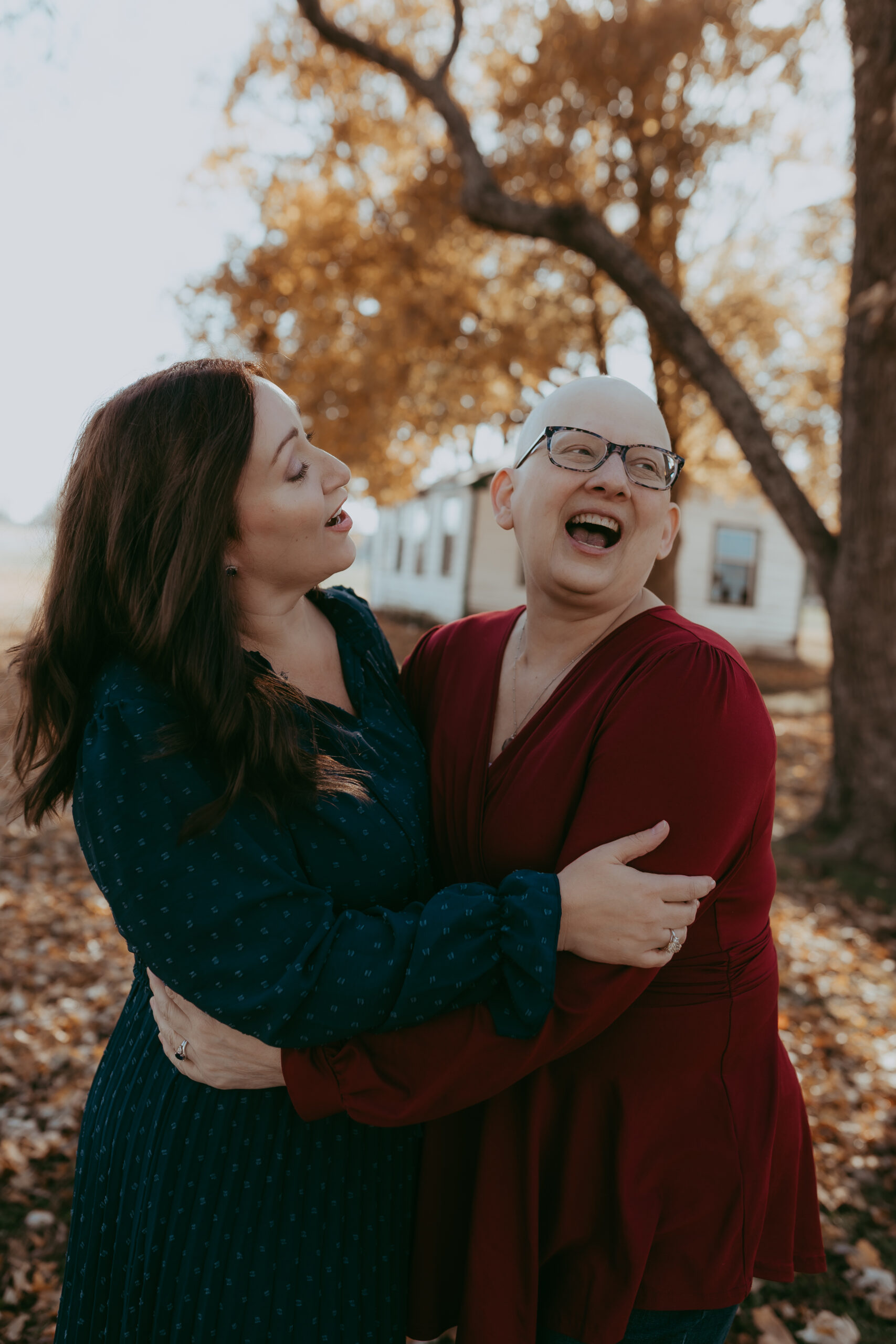

Sara Sweat, MA – Founder, Monarch
Today, I find myself on the unwelcome threshold of grief. It’s been just over a week since my dear friend Angie died at only fifty years old – after living bravely and beautifully with metastatic breast cancer for over eleven years.
Angie was the kind of person who always shows up. Over the many years of our friendship, whenever things in my life fell apart – Angie found her way to my door. She would seek out the unglamorous jobs – cooking, cleaning, painting. Whatever no one else would have thought to do – Angie did without asking. I don’t even know how many times she reprogrammed my Apple TV remote or helped me rearrange the furniture in my house.
My son’s godmother. My travel buddy. My dear friend.
Angie always, always showed up.
And now the person who showed up is gone, and I am learning—once again—how to navigate a world rearranged by loss.
I know this landscape well. As the sole surviving member of my family, I have buried nearly everyone I love – grandparents, parents, my brother, much of my extended family, and now my fourth dear friend.
I am well acquainted with grief.
The Cycle of Not Grieving
But being acquainted with something is no guarantee you will do it well.
For most of my life, I didn’t grieve. I learned the motions, the routines, of death. A few days of visitors to your home. A parade of well wishers at the visitation. A stoic funeral, a solemn burial, a division of assets. Death was a polite and tidy visitor that lasted a few days to a few weeks and then moved on – with or without me.
No one talked about grief.
I was only fourteen, when my dad died. My mother’s deep and overwhelming grief took up all the air in the room. There was no space for mine and there was far too much to be done. My mother needed tending, my brother needed minding, and my family needed comforting.
So, I did what so many of us do – I shoved my grief down and became the person who functions. The one who achieves, for everyone—who cares, for everything – and keeps some semblance of “us” together.
It served me well for a time. It helped us all survive. It led me to achieve. And, then eventually – it kept me from actually enjoying the life I’d worked so hard to create.
This is the cycle I’m trying to break.
Abandoning myself – my own feelings, needs, and desires – until everyone else was ok, was a requirement in those early days of my life. Now, it’s just a script – a default. A way of reenacting the past and re-injuring me – leaving less of myself to love everyone who is still here.
I will not teach my son that death is something to manage.
I will not teach him to politely grieve.
I will show him how to welcome our grief – to sit with it at the kitchen table, pour it a cup of tea, and honor its sacred presence in our home.
We will let our grief move through us and transform us as we fully feel the vacant space of Angie’s loss.
Grief expert and bereaved parent, David Kessler writes, “Each person’s grief is as unique as their fingerprint. But what everyone has in common is that no matter how they grieve, they share a need for their grief to be witnessed.” Not lessened. Not reframed. Seen.
In the early losses of my life, no one witnessed my grief. So it went underground, calcified, and became the foundation of a false self built to function rather than feel.
What It Looks Like to Break the Cycle
This time, I’m doing it differently.
The morning after Angie died, I shared the awful news with my son. After a few initial tears, his instinct was to distract—to turn on the TV and numb his uncomfortable feelings. But, that would have only delayed what was required – to gently and honestly acknowledge the loss.
So, instead, I poured him some juice and slowly made myself some tea. Taking a precious tin container from the kitchen drawer – the loose leaf tea I purchased just last year in London – I prepared it. I poured hot water over the leaves and breathed in its familiar fragrance as it steeped. I watched the liquid amber as it fell into one of my grandmother’s fine china tea cups and slowly took a sip. It’s a ritual, a small way I care for myself, but this morning it felt hushed and holy.
We sat on the floor and played together. Silently arranging blocks, toy soldiers, and dinosaurs for an epic battle. We built barricades out of legos and discussed the most strategic location for their use. Through the warm morning light – we connected. In the sacred, unhurried space, the words found us and we began to speak. He asked questions, I offered answers. We bore witness to each other. We made observations, recalled memories, and let loose more tears.
We invited our grief in, poured it a cup of tea, and drank.
Author and psychologist, Peter Levine teaches that trauma isn’t what happened to us—it’s what happens in the absence of an empathetic witness. We cannot be protected from the loss, but we can create the conditions to prevent the loss from becoming the trauma.
In our home, grief is allowed, encouraged, witnessed, and respected. We know it will look different from day to day. It will bring changes – both generous and brutal. And, painful as it may be, we will welcome them all.
His experience of grief will be different from my early losses. It will move. It will change. It will expand. And, through that difference, grief will break the cycle.
The Truth About Grief
Author C.S. Lewis, writing after the death of his wife Joy, described the process of grief like this: “For in grief nothing ‘stays put.’ One keeps on emerging from a phase, but it always recurs. Round and round. Everything repeats.”
This is true. Grief is not a state – but a wave. Just as death is not something you get over – but something you grow around.
I don’t pretend any of this is easy. I am disoriented every day. Making even simple decisions feels impossible. My body demands rest at the most inconvenient times. I keep forgetting what I was saying, what I was doing, who I was meant to call. If I am showered and dressed – it’s a small miracle and I’m watching The West Wing like it’s my job.
But, I will not shame myself for any of this. I will listen. I will witness. And, I will trust that what my mind and body are telling me – is the truth.
So, I rest when I need to rest. I talk when I need to talk. And, I believe my body’s cries – instead of demanding it push through them to meet my unrealistic expectations.
If I am to break the cycle of polite and disjointed grief, I have to start with myself. Because no one will witness my grief more completely than I.
We live in a grief illiterate society. We are taught to say “let us know how we can help” and “we’re sorry for your loss”, then go right back to the sanctuary of our own undisturbed realities.
There are no Hallmark cards for the overwhelmingly myriad ways loss touches our lives. No bereavement scripts for losing your chosen family or for loved ones lost to addiction. No casseroles baked for a career collapse, relationship betrayal, the death of a pet, or the loss of a dream.
We all mean well, but we do not do this well – at all.
At least until it happens to us. And, then we learn what we all eventually learn – that every loss matters. That showing up matters.
That choosing to do something – make a meal, share a story, pour a coffee, send a note – brings connection and bears witness; making the primal flow of grief easier to bear.
We learn that bridging the gap of disconnection with presence – is the greatest gift of all.
Maintaining Connection
Because connection is really what breaking the cycle is all about. Many cultures understand what we in the modern West have forgotten: that death ends a life, but not a relationship.
In Mexico, Día de los Muertos celebrates the continuity of generations through loving reunion with those who came before. In traditional Jewish mourning, the shivah creates dedicated time for grief—a week where the mourner is surrounded by community followed by a year when life pauses to reflect. In Māori culture, the tangihanga involves days of rituals, stories, songs, and dances to honor the dead. In many Native American traditions, the dead are not seen to “pass away”— but “walk on,” continuing the journey in a place we cannot see.
These cultures create space for grief to be public, communal, and ongoing. They build altars. They tell stories. They make the deceased part of the living world.
Because the goal of grief is not to accept the death – but to fully live beyond it.
I maintain connections with my loved ones by including them in my life. I talk to those I’ve lost. I ask them for signs. I place images of them on a permanent ofrenda in my home. I celebrate their birthdays. And, I share stories about them with those I love, inviting their memory to live on – outside of me.
For Angie’s birthday this July, my son is already planning a celebration; filled with games, puzzles, and a “giant, sink sized, bowl of ice cream for everyone to share.” You have all been invited to join.
As Kessler writes, “When someone dies, the relationship doesn’t die with them.” The relationship transforms, continues, and becomes something new. But, the one thing it could never do, is end.
Letting Grief Change Us
Allowing grief to change us means to acknowledge that we are different on the other side of loss. We can no longer be who we were because part of our story is gone. Because the tiny part of us that only existed in the reflected gaze of our loved one – disappears in their absence, too.
And, we must mourn for who we will no longer be.
But, our story – our connection – goes on. Our life becomes their legacy. And, we transform – not into a container of their memories but a living testament to their life. To live with them. To live for them. To live.
If we do—if we lean into the grief rather than away from it—we’ll begin to unearth a twisted and brambled path toward a life that holds more meaning and beauty than the one we knew before.
An Invitation
If you’re reading this and navigating your own loss today, here’s what I want you to know.
You’re not alone.
Everyone who has ever lived has lost. And, even if you feel like you’re on an island right now and no one else understands – this whole world is marked by grief. Give it time. Let others catch up. You may just be leading the way.
Nurture your relationship with your loved one.
Talk to the one you’ve lost. Tell their stories. Remember what made them special. Continue their traditions, leave a space for them at your table, hang a picture in your home. Invite them into your life and give your love somewhere to go.
Your grief is for you.
Grief is not here to hurt you, it’s here to help you heal. Invite it in, turn down the noise so it can speak, and listen. Trust what you’re feeling. And, honor it—even when it’s inconvenient or other people don’t understand.
Ask for what you need.
On the rare occasion that you actually know what you need – ask for it. When people say “let me know what I can do”, tell them you have no clue. Let them just pick something and do it. Then, receive it with open arms.
Do it differently.
Most importantly, give yourself permission to do it differently. Honestly. Authentically. To break the cycles of self-abandonment, of pushing through, of stuffing it all down.
Your grief is trying to teach you something. Allow yourself to learn.
As C.S. Lewis said: “Grief is like a long valley, a winding valley, where any bend may reveal a totally new landscape.”
We never know what’s around the bend in our grief. But if we keep walking—keep moving – we might just find that the new landscape, though different, holds its own kind of gift.
We will find ourselves changed – that is true. But, that change might be exactly what we need to finally come home to our life.
If this post resonated with you and you’d like someone to walk you through your authentic grief, Monarch is here. Subscribe for free and let’s continue the journey together.