



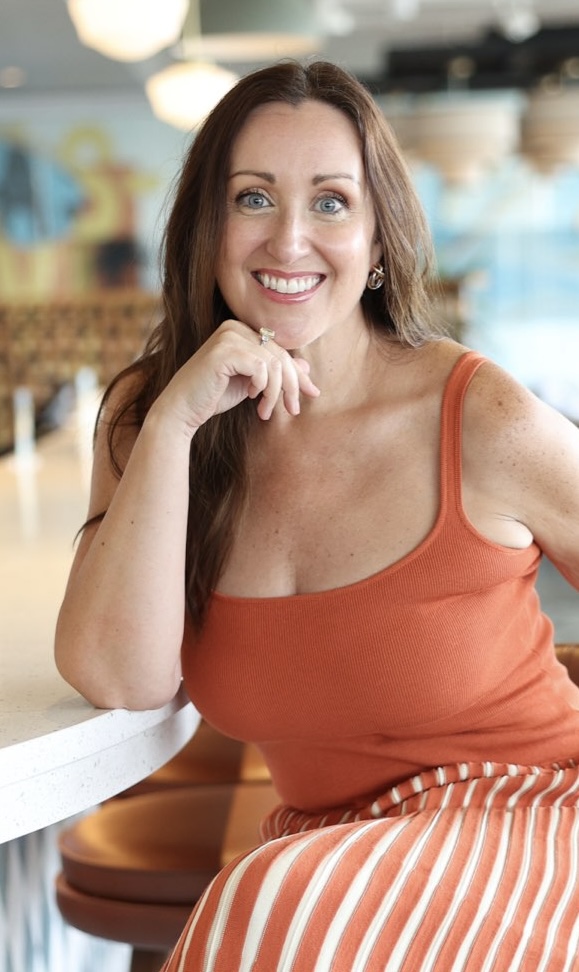
Sara Sweat, MA – Founder, Monarch
“I bought a cherry pitter because of you. Eating pitted cherries makes me feel like a queen.”
The night before I received this text, I hosted a small group of working moms for dinner. Sharp, funny, deeply capable women who are building careers and raising families with an equal emphasis on both.
We meet monthly, not because we have extra time, but because we need somewhere to tell the truth about what this actually feels like.
It’s collaborative. Supportive. A little bit of relief in the middle of our very full and overly responsible lives.
Everyone brought something to share. I made a Mediterranean salad I learned to make years ago in Greece. Tomatoes, cucumbers, olives, and spices that were easy to dice and combine before my guests arrived.
I also served a bowl of pitted cherries.
Because here’s the thing about cherries: everyone talks about how life is just a bowl of them, as if it symbolizes ease. But cherries aren’t easy.
You take a bite, hit the pit, and work around it, while you carefully extract it from your mouth. Your hands get covered in cherry juice which inevitably winds up on your white jeans and you regret the whole operation.
They’re good. But they’re work. Unless someone has already done the work for you.
When you pit cherries, you get the work out of the way up front with a tool designed for exactly this purpose. Then, when it’s time to eat, you get all the benefit with none of the friction.
That’s what my friend felt. Actual ease. Presence. Joy.
What struck me wasn’t just that she appreciated it—it was how easy it is to forget we can create these experiences for ourselves.
The Infrastructure of Our Lives
I’m a business consultant by trade. I work every day with small businesses and startups that are trying to launch important, complex things into the world.
And, the greatest asset they have in their attempt is their infrastructure.
The small, often invisible ways we design process and procedure will either get us closer to our goals or distract us from them.
As individuals, it works the same way. The infrastructure of our lives is actively either depleting us or supporting us.
Most high-performing women—especially mothers—are living inside systems that are built almost entirely around output. Specifically, their output. There are emails, logistics, meals, practices, deadlines, decisions. There is always something being asked of you.
It’s not a state of mind. It’s an operational reality. When you have children, especially early on, your needs do move to the back burner in tangible ways. There are seasons of life where you simply cannot get it all done.
But what often doesn’t shift back is the system that surrounds that reality.
We keep living in structures that require constant output, with almost nothing designed to pour back in.
We tell ourselves self-care is something we’ll do later. Something that requires time we don’t have. A spa day. A vacation. A break from our life.
But what if the goal isn’t to escape your life but to build a life you don’t need to escape from?
Life Curation
Self-care, for the people I work with, isn’t about stepping out of your life.
It’s about changing how your life feels while you’re inside it. About building a life that supports everything that matters – including you.
I call this process Life Curation.
It’s using a milk frother to blend the creamer in your coffee instead of the spoon.
It’s lighting a candle in your office or at the end of the day.
It’s creating a playlist for your morning commute that hypes you up and one for your drive home that transitions you back.
It’s using the good hand soap. Keeping your favorite lotion in your bag. Or, buying multiples of the water bottle you actually like – instead of using the one with the broken handle your picky teenager tossed aside.
One of my clients carries dark chocolate in her purse everywhere she goes. When she’s done with a meal and craving something sweet – she doesn’t deny her impulse, she meets it – with a beautifully prepared treat that reminds her that she matters, too.
These tiny rituals are different for everyone. But noticing what brings you back to the present moment—and making access to it easier is the key.
We shouldn’t think of these small investments as indulgences – but deposits.
Debits and Deposits
If you think about your energy like a bank account, most of us are operating at a deficit.
Add any kind of trauma in your background — and you may already be starting your day overdrawn. When you start out behind, it doesn’t take much to push you past your capacity.
You raise your voice while asking your child to put on their shoes for the 27th time this week. You send that email with a little more snip in your tone than you intended. It becomes all too easy to respond in a way that’s not congruent with the reality of the problem you encounter.
In psychology, this range in which you can function, respond, and regulate without becoming overwhelmed is called your window of tolerance.
For many of us “strong ones”, we’ve gotten so acclimated to operating outside our window of tolerance, we don’t even realize we’re doing it.
Our life is full of debits and almost no deposits, and it’s probably always been that way. We just keep going because not having enough fuel in the tank was never a reason to stop before.
We have to intentionally build more deposits into the infrastructure of our life. To widen that window of tolerance – not by pure brute strength, but by design.
We make small, consistent deposits that bring us back to ourselves—over and over again.
Why We Don’t Do It
The men and women I work with aren’t sitting around thinking, “I don’t deserve to be cared for in this way.” They don’t feel guilty for taking time for themselves or feel ashamed about needing rest.
They’re not thinking about themselves…at all.
When you’ve been hyper-functioning for so long—at work, at home, in every role you occupy—you lose touch with what you like, how you feel, and what actually restores.
We know how to give, push, achieve, and earn. But, we don’t even know what we want.
- So, we try to book a spa day, but something comes up and we have to push it.
- We take a pottery class, have a great time, and find 20 missed messages on our phone when it’s done.
- We finally go on that girl’s night and wind up remotely managing our kid’s bedtime instead of connecting with our friends.
Then, we wonder why we’re still so tired. We decide it’s easier to just never leave the house and fill our lives with schedules, routines, and responsibilities that zap the life right out of us.
In trying to plug one big hole in the damn we create a thousand tiny cracks in the process.
Start Small
If you’ve never prioritized yourself, trying to make big changes will create way more chaos than it solves. You have to begin with something small. With noticing. With observation.
You know that hot person you secretly liked in college? You know the one. Cool in a way you still can’t quite describe. Always knew the perfect thing to say. Made you blush when they looked at you – which you always wanted them to do, but also kind of didn’t – because it was like they could see into your soul?
Which dorm did they live in? You still know it, don’t you? And, the car they drove or the notebook they had or whatever other small detail you noticed and cataloged about them all those years ago. The arbitrary facts about their life are still on your hard drive because they were important.
That’s how I want you to notice…you. Like you’re the hot guy in econ who smells like honeysuckle and leather. Like you’re interesting and important and cool.
Move through your week and pay attention.
- What lights you up?
- When are you most present?
- When do you feel grounded, centered, and most like yourself?
You’re going to be tempted to cite the times when you didn’t feel stressed. That’s not what we’re after. The absence of discomfort without presence – is numbing.
I want you to engage your senses. What smells, tastes, sounds, and experiences were you fully present for this week?
Those are your deposits.
Then, you just have to make it easier to get more of them.
- Buy the cherry pitter.
- Get the milk frother.
- Keep the really good, stupidly expensive soap by the sink.
Create a life where the things that nourish you are not rare—they’re built in. They are part of the infrastructure.
When the system that surrounds your life makes it easier to care for yourself than to neglect yourself, everything changes.
Audit The Calendar
Sometimes with my clients, we do a simple calendar audit.
We look at the week ahead—not just in terms of what’s scheduled, but in terms of energy.
Where are the debits? What are the deposits?
If their calendar is full of output with nothing coming back in, we redesign. Shift things around until there’s as much coming in as is going out and you’ll start to climb out of the hole.
My friend who bought a cherry pitter didn’t change her whole life overnight. She changed one small thing. But that’s how this works.
The little things are the big things.
And when you start treating them that way—when you build a life that supports you in small, consistent ways—you don’t just feel better.
You become someone with more capacity.
More presence.
More room to lead, to parent, to decide, to live.
Not because you pushed harder, did more, and addressed everyone else’s needs. But because something is finally pouring back in.
Monarch is where high-capacity people learn to build lives that actually sustain them. We are a sanctuary for the strong.
Want Sara’s recipe for Mediterranean Salad? DM us here. And, if you’re ready to stop surviving your life and actually live it, let us know.




Beautifully said!
Thank you so much, Jenn!