
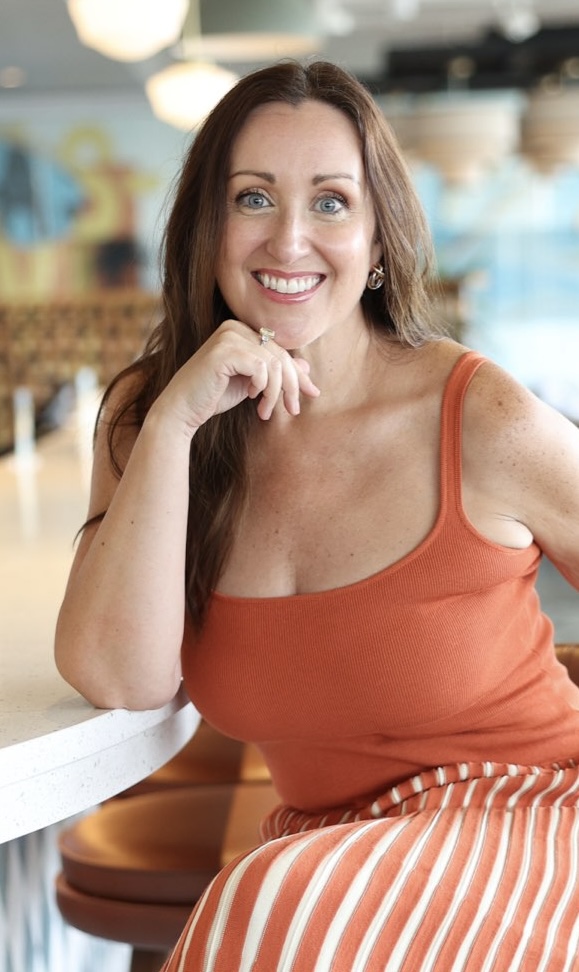
Sara Sweat, MA – Founder, Monarch
There comes a point in the life of every overly capable person when they look around and think, “Am I the only actual grown-up here?”
Because somehow, in your house, in your family, in your work, or in your relationships, you became the one who sees everything, carries everything, remembers everything, and decides everything.
You are the default adult.
You’re the one who notices the form that still needs to be signed, the groceries that need to be replaced, and the text that requires an immediate response. You see the emotional dynamic no one is naming, the deadline that cannot be missed, and the pile at the bottom of the stairs that apparently has entered into a long-term lease agreement with your foyer.
And if you’re honest, part of what makes this so maddening is the way other people help.
They’ll do what you ask. They’ll finish a simple task before they return to their life of leisure and support.
But you’re still the one who has to notice, organize, assign, remember, instruct, and make sure it actually gets done.
That is not shared responsibility. That is management.
And being the full time manager of your & everyone else’s life is exhausting.
The problem isn’t just the work
Most people think the burden of being the default adult is the number of tasks.
It’s not. It’s the number of decisions.
It’s the mental load of constantly tracking what matters, what’s late, what’s coming, what’s missing, what needs attention, and what will fall apart if you don’t step in. It’s the burden of knowing that even when other people are technically participating, you are still the one carrying the cognitive and emotional load of making life function.
That’s why what triggers the breaking point in default adults, is rarely dramatic. It’s not big life changes or traumatic events.
It’s someone asking what’s for dinner.
It’s one more person needing one more thing.
It’s realizing that the stuff at the bottom of the stairs has multiplied so rapidly that your eye has started twitching, and you are about two seconds away from delivering a TED Talk called Why Am I the Only Person With Eyeballs?
That’s not an anger problem. That’s decision fatigue.
Why this role is so hard to leave
If you’ve been the default adult for a long time, this role can start to feel like your personality.
For a lot of high-capacity people, these skills were built in environments where we really did have to do more than everyone else. Where we had to notice what others missed. We had to anticipate needs. We had to be responsible before it was developmentally appropriate and be the most emotionally functional person in the room when we were also the littlest.
So now, even if life looks different, our defaults do not.
Our nervous system still assumes: if we don’t do it, it won’t get done. If we don’t hold it all together, something bad will happen. We can’t rest, because if we do, everything will quietly fall apart.
And to be fair, we usually have enough lived experience to make that fear feel very convincing.
You can want a different life and still keep recreating the old one, because your default pattern fires before your conscious mind has time to intervene.
That’s why you need something that operates entirely outside your own conscious mind.
You do not need more willpower
We’ve built the lives we have through sheer willpower alone. We don’t lack power over our will.
We’ve honed our communication skills, learned to ask for help. We’ve become more disciplined, more efficient, and even practiced in the impossible skill of learning to let it go.
But for the default adult, the deeper solution doesn’t require more effort.
What’s needed is a redesign of the infrastructure of our lives.
If your life still depends on you noticing everything, remembering everything, initiating everything, and recovering everything, then of course you are exhausted. You are not living in a supportive system. You are the system – and everything else depends on you.
That’s straight up survival training. Putting your finger in the damn can stop a leak. But, if someone doesn’t actually fix the crack that created it, your whole life becomes about preventing disaster and it shrinks in response.
Survival strategies do not create sustainable success.
If you want your next chapter to look different than your last, you cannot keep using the same operating system you’ve been using all along. You cannot keep being the emergency contact, the air traffic controller, the quality assurance department, the project manager, and the emotional support animal for everyone in a fifteen-mile radius of your head.
Maybe, for once in your life, the answer is not “try harder” but “build differently.”
Build for sustainability, not survival
Survival asks, “How do I stop the bad thing from happening right now?”
Sustainability asks, “How do I protect my energy so I can respond to whatever is happening right now?”
This is a completely different question.
When you are building for survival, you keep your finger in the dam. You patch. You scramble. You absorb. You overfunction. You do whatever is necessary to prevent immediate disaster, regardless of what it costs you.
When you are building for sustainability, you design redundant systems that actually support where you want to go & who you want to be when you arrive.
It starts by observing your defaults.
Where are you automatically stepping in?
Where are you assuming no one else will handle it?
Where are you carrying responsibilities that should be shared, delegated, systemized, or allowed to exist in spite of the consequences they create?
Where are you still living as though your job is to prevent every possible failure?
Answer those questions and you’ll have a roadmap of your defaults.
Resisting change
“But, Sara, no one else is coming to help me in my life!”
I know, sweetheart. I’m a solo parent with no living family and a businesses to run. I don’t have an army of support either. That’s why we have to get this right.
Because you are the most valuable resource in your life and you’re treating yourself like you’re expendable.
“But, Sara, everyone depends on me. I can’t just tell them all to figure it out on their own. They’ll implode.”
Sweet reader. Designing the infrastructure of your life is not going to ask you to stop loving people, stop showing up, or stop being who you uniquely are.
It’s just going to enable you to stop operating within a structure that’s built on you constantly overextending yourself to the point of burnout and fatigue.
Because that’s what happens when you stay the default adult too long: you burn out. You get resentful, you start micromanaging, you lose access to rest, and important parts of your life either become overly controlled or quietly neglected.
You look highly competent from the outside while internally – you’re fantasizing about throwing your phone out the window and disappearing to a luxury hotel with room service and for 72 consecutive hours.
Dreaming of escaping your life is not a sign that you are failing.
It’s a signal – that the design of your support is crap.
What a different next chapter requires
A different next chapter requires you to have different support. To set up a system of external defaults that prevent you from operating the way you always have.
It’s about reducing the number of decision points that hit your already overworked internal system so you aren’t actually expected to carry it all.
It’s tools like shared calendars, actual shared ownership, and a system of checks and balances for your household.
It’s process like workflows, boundaries, intentional support, and flow optimizing design. An infrastructure for life that’s not built on you – but for you.
It also requires a painful but freeing truth: people may need to feel the effects of their own choices in order for the system to change.
This is hard for default adults, because we have spent so long absorbing the consequences for everyone else, it hurts to watch people suffer from their actions.
But there are lessons that only get learned the hard way – and that rule doesn’t only apply to you.
This is the Monarch work
This is exactly why coaching for high-capacity people has to be different.
People who have spent years surviving do not usually need more advice on discipline, productivity, or performance. They already know how to push. They know how to carry. They know how to get exceptional results – but it almost always comes at unsustainable personal cost.
What’s typically foreign to this population is rest, enjoyment, support, and sustainable success. They’ve built a life on running a marathon at the speed of a sprint – but the cost of that pace is starting to catch up.
At Monarch, the work is not about squeezing an extra 2 percent of output from someone who is already overfunctioning. It’s about helping people design a life that does most of the work so they don’t have to.
It’s about moving from over burdened to fully supported. From surviving to thriving. From managing the world from one exhausted spot to charting a course that allows you to see the world and soaring to your chosen destination with ease.
The real invitation
If you are the default adult in your world, congratulations. You already have everything you need to build the life of your dreams. You’ve got more adaptive strategies in your toolkit that most people ever collect.
We aren’t going to ditch everything you’ve learned how to do. We’re just going to set it to task on something other than survival.
We’re going to widen the aperture of your life to move beyond getting through it – and start enjoying it instead.
Your days of being the default adult are numbered. And the time of your life is just waiting in the wings.
Monarch helps high-capacity people build the internal and external infrastructure for sustainable success. If you are tired of being the default adult and ready to create a next chapter that actually supports you, coaching may be the next right step.
Set up a free exploratory call and let’s replace some of your defaults with ease.